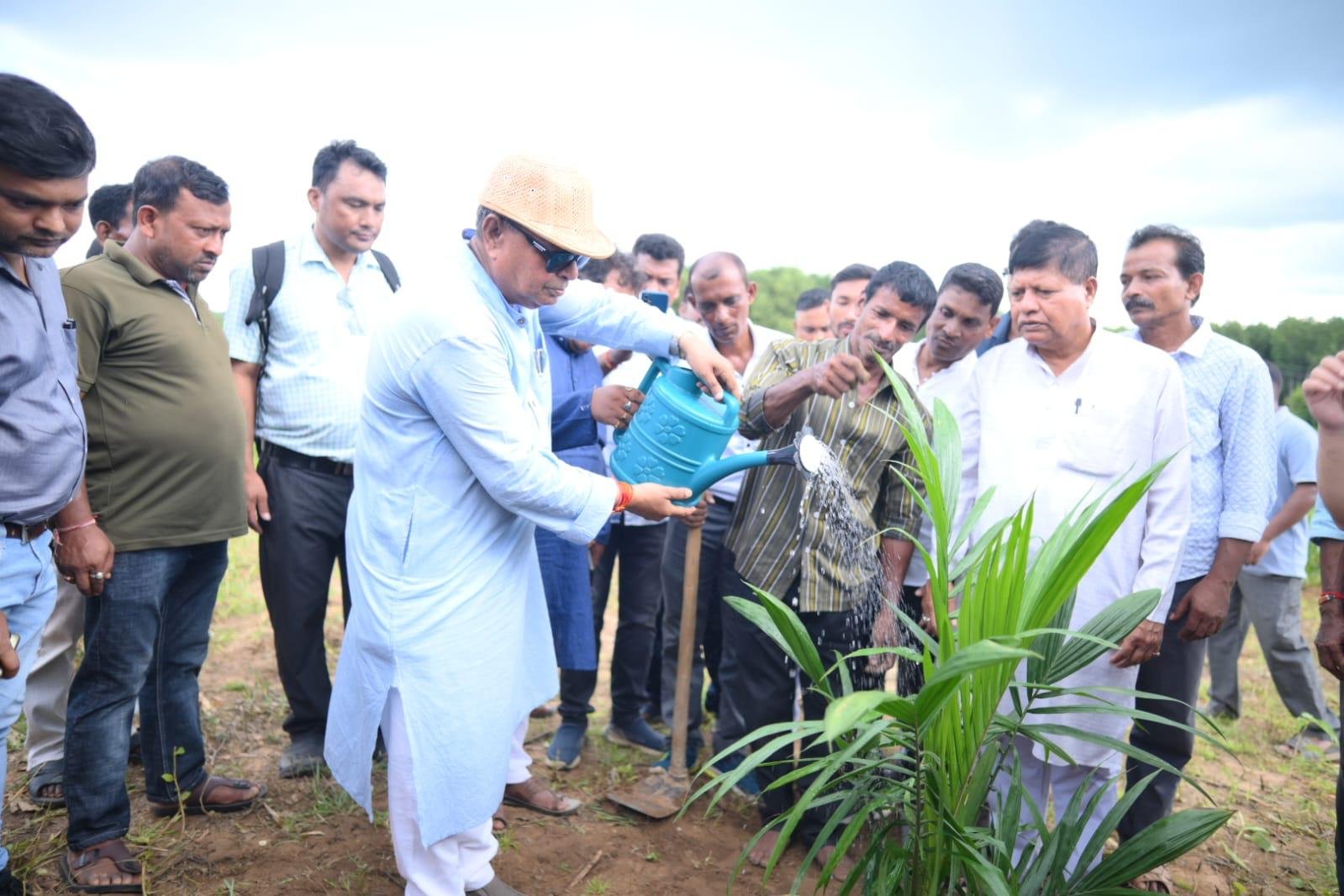
Agartala, September 02, 2025: Agriculture & Farmers Welfare Minister Ratanlal Nath on Tuesday emphasized that the future of Tripura’s development rests on agriculture, tourism and allied sectors like horticulture, fisheries, solar energy and forest resources. He said the state is working with a vision of sustainable growth where farmers will remain at the center.
Speaking after the launch of a palm oil plantation program at Fatikcherra tea garden, Nath said, “Farmers are the main driving force of Tripura’s development. Without agriculture and allied sectors, development is not possible. That is why we are working to utilize our natural resources effectively.”
Highlighting the significance of the palm oil initiative, the minister said India is still dependent on imports for edible oil. “A huge amount of money goes abroad because we are not self-sufficient in this sector. Prime Minister Narendra Modi has stressed on becoming self-reliant, and this project is part of that vision,” he remarked.
Nath revealed that agreements have been signed with Godrej Agrovet and Patanjali for palm oil cultivation across districts. “Godrej will operate in North, Unakoti and Dhalai districts, while Patanjali will work in Khowai, West, Gomati, South and Sepahijala. They will establish nurseries, sapling distribution units, processing centers and special factories at the district level,” he said, adding that farmers will be able to sell palm oil directly from their farm gates.
The minister further assured that farmers would soon get better support. “At least one ‘one-stop solution center’ will be set up in the state to provide farmers with all necessary assistance,” he announced.
On Tripura’s economic growth, Nath pointed out that the per capita income has risen from Rs 1.40 lakh before the present government took office to Rs 1.98 lakh today. “By 2030, we aim to raise the per capita income to Rs 3.70 lakh, and by 2047, it will reach Rs 19.86 lakh. With rising income, we also want the farmers’ earnings to double,” he asserted.
He also noted that the soil of Northeast India is highly suitable for palm oil cultivation, similar to South India, where it already thrives. “This project will not only strengthen self-reliance in edible oil but also boost the income of local farmers and communities,” Nath said.