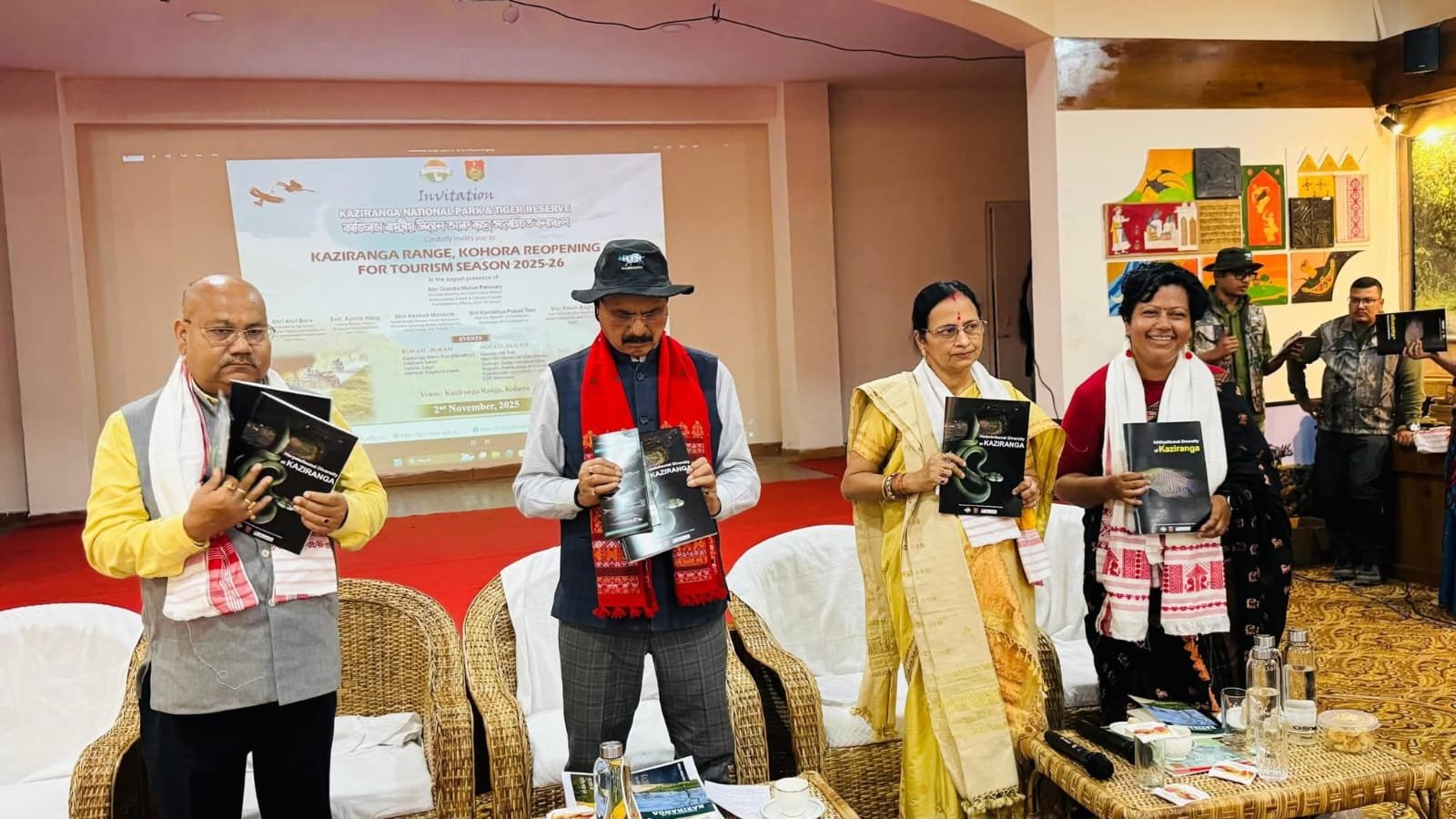
Kaziranga National Park and Tiger Reserve has revealed new findings showcasing its exceptional aquatic and herpetofaunal diversity. The reports, released on Thursday, are based on a rapid survey conducted between July and September 2025 in collaboration with scientists from the Wildlife Institute of India.
The survey recorded 77 species of freshwater fish, representing a significant portion of Assam’s 216 indigenous fish species and contributing to the Northeast’s total of 422 native species. Field Director Dr. Sonali Ghosh stated that Kaziranga also hosts 108 species of amphibians and reptiles—over half of the 274 herpetofaunal species documented in Northeast India.
“Amphibians and reptiles are key indicators of ecosystem health and play vital roles in maintaining ecological balance,” Dr. Ghosh said, underlining the park’s importance as a refuge for wildlife.
The reports, along with the park’s annual report and a poetry collection by Dr. Tapti Baruah Kashyap, were formally released on November 2 at the Kohora Convention Centre by Assam Environment and Forest Minister Chandra Mohan Patowary. Chief Minister Himanta Biswa Sarma shared the news on social media, describing Kaziranga as a “lively acquaintance of Assam” and commending the state government and forest teams for ongoing conservation efforts.
The survey recorded 44 fish species, with Cyprinidae and Danionidae being the most dominant families. Combined with earlier studies, Kaziranga’s total fish diversity stands at 77 species, including conservation-priority species such as Wallago attu (VU), Parambassis lala (NT), and Clarias magur (EN). The report emphasizes the role of fish in nutrient cycling and food webs, while warning of threats like climate change, siltation, and unregulated fishing, and calls for stronger conservation and long-term monitoring of aquatic habitats.
A parallel report on herpetofaunal diversity recorded 31 species—17 amphibians and 14 reptiles—during the survey. Researchers applied AI-based passive acoustic monitoring to enhance detection of amphibian calls across habitats. Kaziranga’s total herpetofaunal diversity now stands at 108 species, including rare and threatened species such as the King Cobra (Ophiophagus hannah), Assam roofed turtle (Pangshura sylhetensis), Asian Brown Tortoise (Manouria emys), and the endemic Cyrtodactylus kazirangaensis (DD).
Dr. Ghosh said the findings reaffirm Kaziranga’s global significance as a living laboratory of biodiversity and a model for integrated wetland and floodplain conservation.