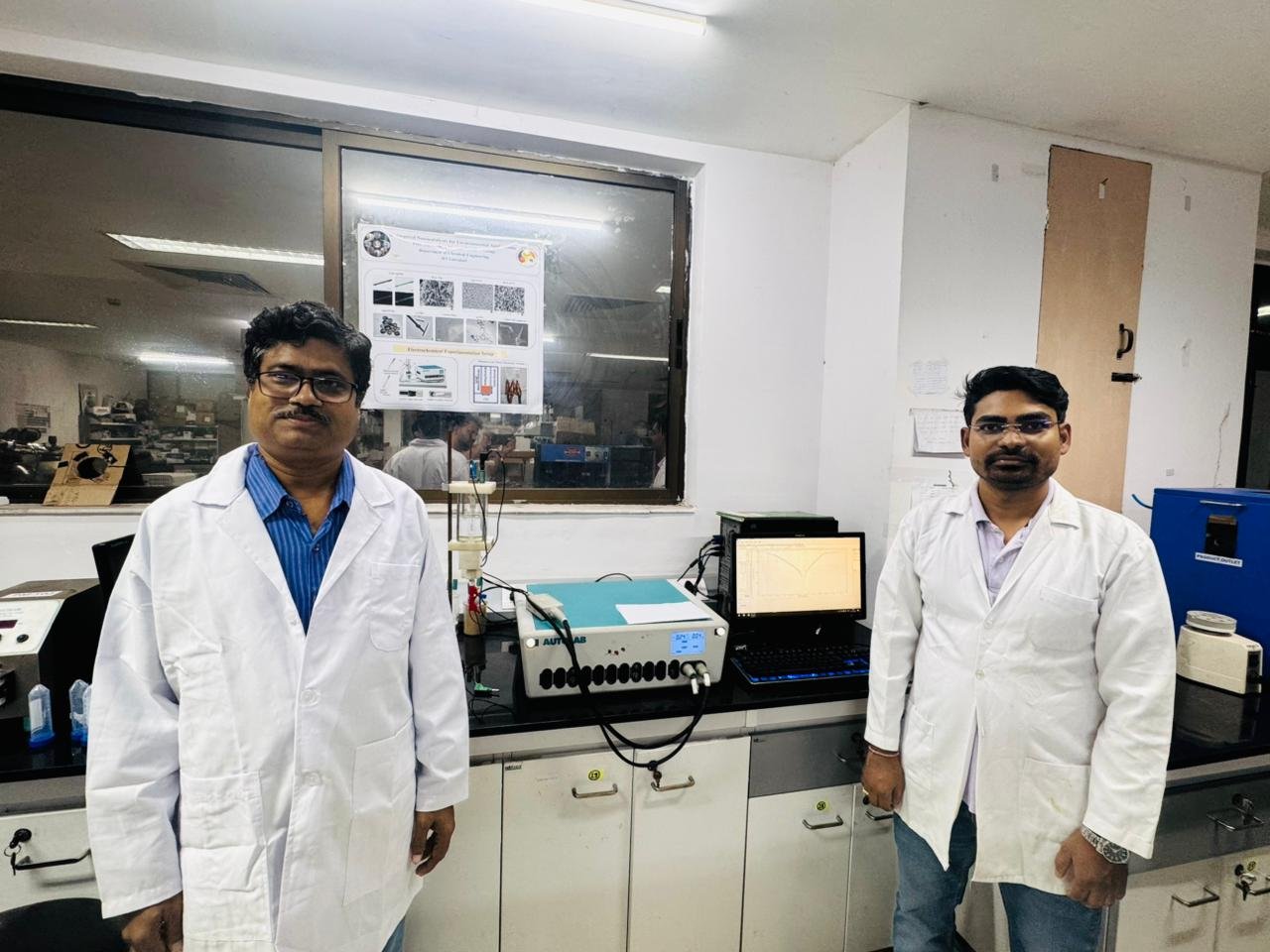
Guwahati, 26 November: Researchers at the Indian Institute of Technology Guwahati have developed an advanced corrosion-resistant epoxy coating designed to protect steel structures exposed to seawater and high-salinity conditions. The findings have been published in Advanced Engineering Materials in a study co-authored by Chemical Engineering faculty member Chandan Das and research scholar Anil Kumar.
Corrosion remains a major challenge for offshore platforms, coastal bridges, port facilities and marine pipelines, where saltwater exposure accelerates metal degradation. It has also contributed to serious industrial incidents, including the 1984 Bhopal gas tragedy and the 1992 Guadalajara explosion.
Standard barrier coatings often develop microscopic defects that allow moisture and salts to reach the underlying metal. To strengthen protective coatings, researchers globally have been exploring nanomaterials. The IIT Guwahati team states that no previous study has combined reduced graphene oxide (RGO), zinc oxide (ZnO) and polyaniline (PANI) within a single epoxy formulation for marine applications.
The researchers developed a nanocomposite by attaching zinc oxide nanorods to reduced graphene oxide and wrapping the structure with polyaniline. This composite was blended into an epoxy base and tested using multiple characterization techniques.
According to the institute, the resulting coating formed a denser and more uniform barrier, showed stronger adhesion to steel surfaces and slowed the movement of corrosive elements more effectively than standard epoxy. The coating may have potential uses in marine infrastructure, offshore installations, shipbuilding and coastal pipelines.
Chandan Das said the incorporation of the RGO-ZnO-PANI nanocomposite provides a promising approach for long-term corrosion resistance, adding that further studies will focus on durability, real-world performance and life-cycle impact.
IIT Guwahati noted that the work adds to ongoing research in corrosion-resistant technologies. The institute clarified that the results are at a laboratory stage and require more validation before any commercial application.