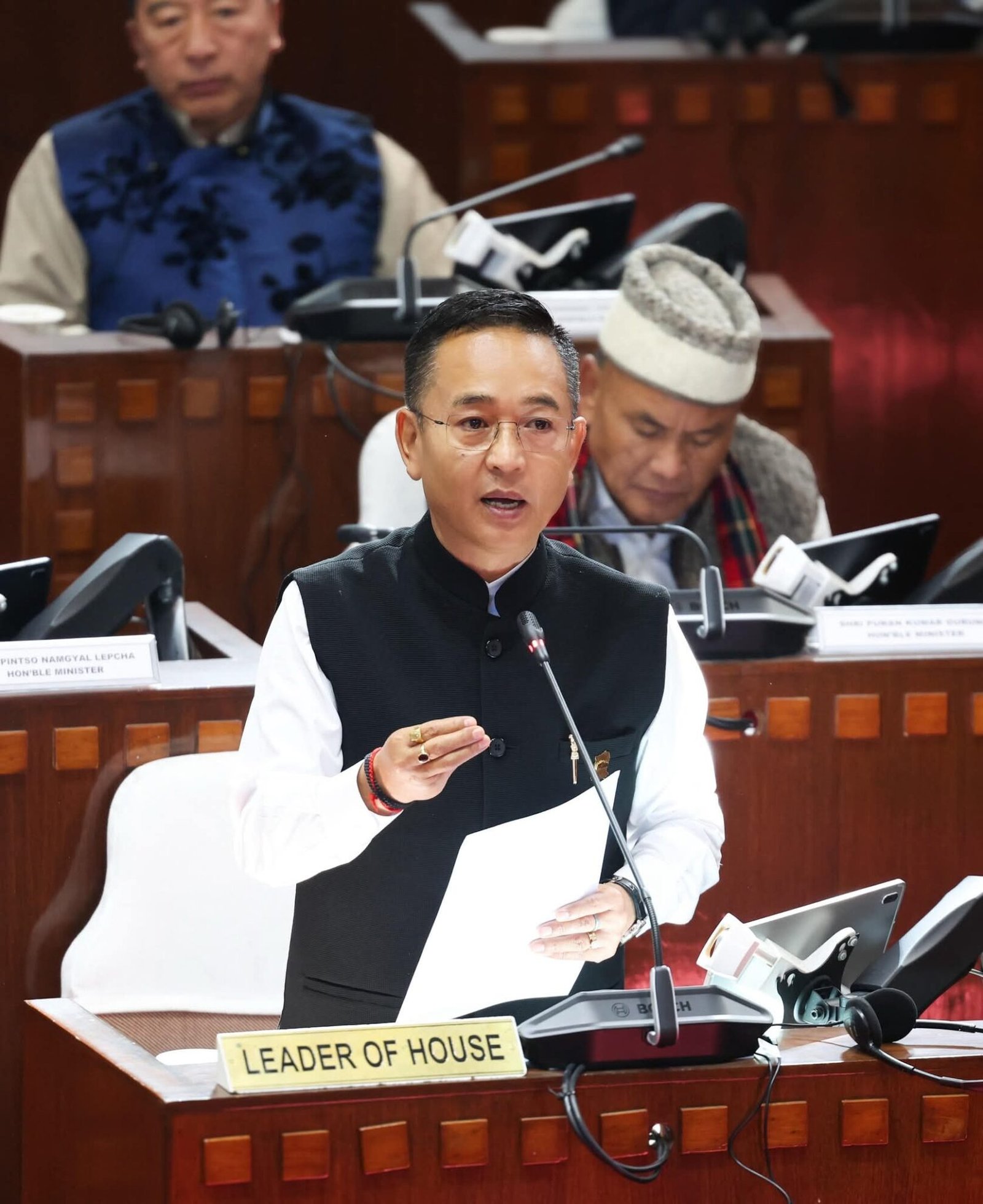
Gangtok, Dec 12: The Third Session of the Eleventh Sikkim Legislative Assembly concluded on Friday with the passage of eight Bills and the adoption of a Government Resolution on the inclusion of twelve left-out indigenous communities of Sikkim in the Scheduled Tribe list. The session was held at the Sikkim Legislative Assembly Secretariat in Gangtok and was presided over by Speaker Mingma Norbu Sherpa.
The proceedings began with obituary references in memory of former Member of the Legislative Assembly Athup Lepcha, followed by a two-minute silence observed by the House. Tributes were paid by the Speaker, Chief Minister Prem Singh Tamang and Minister Pintso Namgyal Lepcha. Athup Lepcha, who represented the Dzongu constituency in 1979, was remembered for his contributions to public life and his work for the welfare of the people of Dzongu.
During the legislative business, the House passed the Sikkim Goods and Services (Amendment) Bill, 2025, introduced by the Chief Minister in his capacity as Minister-in-Charge of the Finance Department. The Bill seeks to amend the Sikkim GST Act, 2017 to strengthen tax administration and simplify compliance in line with amendments made at the central level.
The Assembly also passed the Sikkim Land Revenue Bill, 2025, introduced by the Chief Minister as Minister-in-Charge of Land Revenue and Disaster Management. The legislation aims to consolidate and modernise land revenue laws, provide for digital maintenance of land records and establish revenue courts for resolving land-related disputes.
Two Bills introduced by Public Health Engineering Minister Sonam Lama—the Sikkim Sewerage and Sewage Disposal Bill, 2025, and the Sikkim Water Supply and Water Charges Bill, 2025—were also passed. Both Bills replace ordinances promulgated in September 2025 and seek to strengthen urban sanitation, sewage management and drinking water supply, including provisions for compulsory connections, inspections and metered billing.
The House approved the Jan Vishwas (Amendment of Provisions) Sikkim Bill, 2025, introduced by Law Minister Raju Basnet, which aims to decriminalise minor offences by replacing imprisonment with monetary penalties to improve ease of living and ease of doing business.
The Sikkim Motor Vehicles (Amendment) Bill, 2025, introduced by the Chief Minister as Minister-in-Charge of the Transport Department, was passed to remove discriminatory provisions related to leprosy-affected persons from the Sikkim Motor Vehicles Act, 1957, in compliance with Supreme Court directions.
The Assembly also passed the Sikkim Town and Country Planning (Amendment) Bill, 2025, introduced by Urban Development Minister Bhoj Raj Rai, to make limited amendments to the 2024 Act for improved clarity and administrative efficiency.
The Sikkim Private Universities (Establishment and Regulation) Bill, 2025, introduced by Education Minister Raju Basnet, was passed to create a uniform regulatory framework for private universities in the state, in line with Supreme Court rulings and University Grants Commission norms.
In addition, the House adopted a Government Resolution moved by Social Welfare Minister Samdup Lepcha seeking ratification of the final report of the Sikkim State High-Level Committee on the inclusion of twelve left-out indigenous communities in the Scheduled Tribe list. During the discussion, the Chief Minister said the report was based on extensive field research, consultations and expert inputs, and reflected Sikkim’s unique historical and social context.
During the session, the Chief Minister also presented several audit reports of the Comptroller and Auditor General of India related to state finances, the State Bank of Sikkim and other sectors. Annual reports of various departments and commissions were also laid before the House.
In the valedictory remarks, the Chief Minister and the Speaker thanked the Members of the Assembly, officials and the media for their cooperation during the proceedings. The House was adjourned sine die by the Speaker.