The Directorate of Information and Public Relations (DIPR), Government of Manipur, the department responsible for disseminating official information relating to government policies, achievements, and public welfare programmes, is facing serious public scrutiny after RTI documents revealed significant discrepancies in the procurement of photographic equipment purchased using public funds.
Documents accessed through a Right to Information (RTI) application filed by Khumanthem Dhanachandra show that DIPR procured four units of the Canon EOS R7 at a unit price of Rs. 3,50,000, bringing the total expenditure on the cameras alone to Rs. 14,00,000.
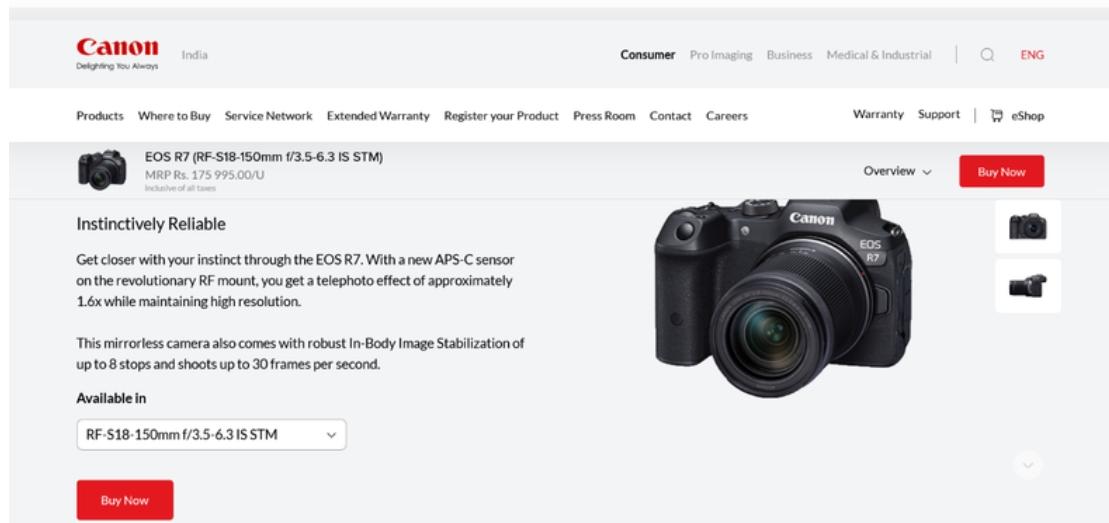
However, a comparison with prices listed on the official Canon India website raises serious questions over the procurement process. While the MRP of the Canon EOS R7 body is listed at Rs. 1,38,995, the MRP of the camera bundled with the RF-S18-150mm f/3.5-6.3 IS STM lens is Rs. 1,75,995, nearly half of the price reflected in the procurement records obtained through RTI.
The invoice dated 9 February, 2026, further reveals that DIPR also purchased one DSLR camera UV filter at Rs. 3,500, one DSLR camera tripod at Rs. 9,000, one DSLR camera lens cap at Rs. 2,100, one DSLR camera cleaning kit at Rs. 5,800, one camera rain cover sleeve protector at Rs. 12,000, one spare battery (8.4V per 700mAh) at Rs. 32,000, one SD card reader at Rs. 600, one 512GB memory SD card at Rs. 25,000, one light reflector plate at Rs. 950, one lens sunshade at Rs. 1,400, and one camera cover at Rs. 6,500, taking the total value of the procured items to Rs. 14,98,850. As per the documents, all the items were delivered to DIPR on 9 March, 2026.
The unusually high pricing of several items, particularly the camera units and accessories, has triggered concerns regarding possible overpricing and financial irregularities in the utilisation of government funds. Questions are now being raised regarding whether proper market surveys, comparative quotations, technical evaluations, and financial scrutiny were conducted before approving the purchases.
The controversy assumes greater significance because the department involved is responsible for communicating government transparency and accountability to the public. Allegations of questionable procurement practices within such a department risk undermining public confidence in institutional integrity and governance.
The RTI documents have intensified calls for an independent and transparent inquiry into the procurement process, including verification of quotations, supplier selection, approval procedures, and the basis on which the prices were finalised. Legal experts and transparency advocates note that if any manipulation of rates, abuse of official position, or violation of financial rules is established during the inquiry, the responsible officials may be held accountable under the relevant provisions of law.
The RTI applicant has stated that he intends to approach an independent investigating agency seeking an inquiry into the matter if the Government fails to initiate appropriate action within two weeks from the date of publication of this report.