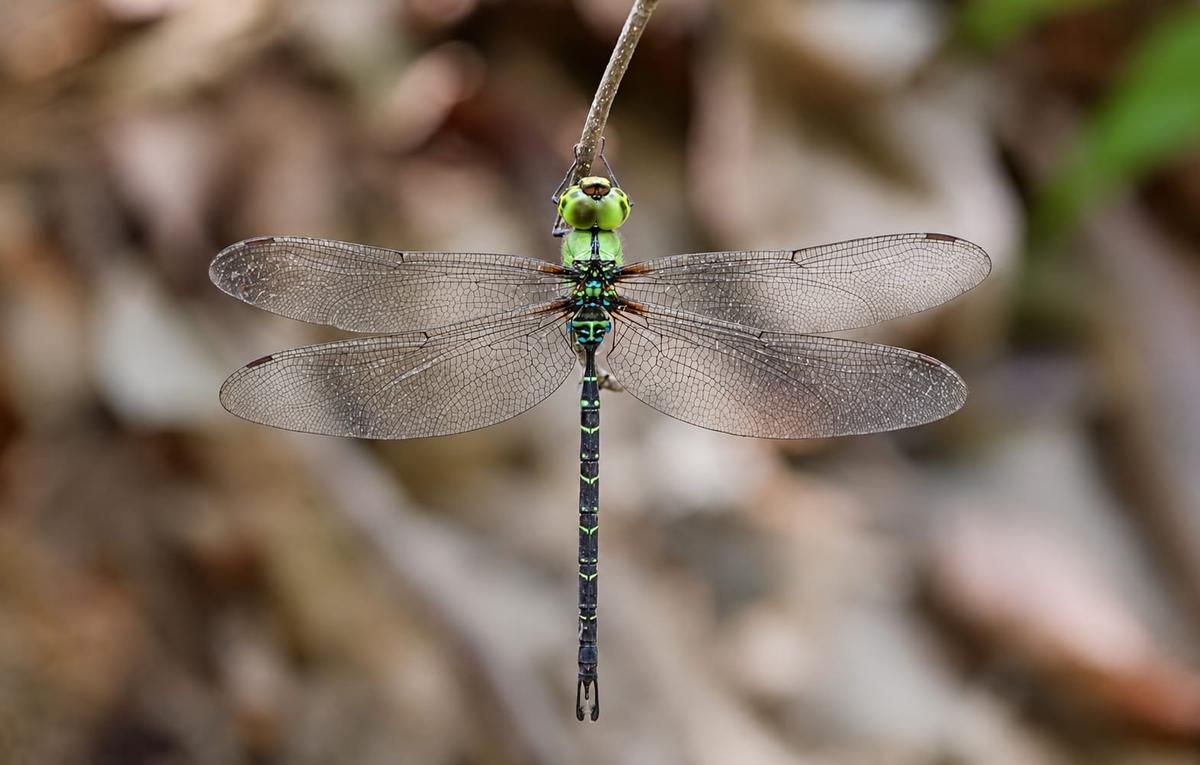
A rare dragonfly species has reappeared in Arunachal Pradesh after more than a century, marking a significant rediscovery in India’s biodiversity records. The insect, Gynacantha khasiaca, commonly known as the long-tailed duskhawker, was last described in 1914 from the erstwhile Abor Hills. In October 2024, a team of four citizen scientists documented the species at Deban in Namdapha National Park and Tiger Reserve, about 600 km east of its original location.
The study, published in the Journal of Threatened Taxa, was authored by Mahesh R. from Kerala, Rajesh Gopinath from Karnataka, Gaurav Joshi from Uttarakhand, and Roshan Upadhaya from Arunachal Pradesh. They confirmed the sighting through photographs taken in the presence of forest staff. The rediscovery highlights the importance of sustained monitoring and habitat protection in India’s easternmost state.
Dragonflies and damselflies, belonging to the order Odonata, play a crucial role in freshwater ecosystems as both predators and prey. Globally, Odonata diversity includes 6,442 species, with India hosting 504 species and 27 subspecies. Arunachal Pradesh alone accounts for 110 species. The genus Gynacantha, which comprises 92 species worldwide, is characterized by large dragonflies with pale brown and green coloration and crepuscular activity.
During the study, the team recorded 17 Odonata species, including Trithemis aurora, Neurothemis fulvia, Orthetrum glaucum, Aristocypha spuria, and Neurobasis chinensis. The highlight was a single male Gynacantha khasiaca observed on October 16, 2024, along the Miao-Vijoynagar Road at 600 m altitude. The specimen was seen patrolling and hovering while defending its territory.
Beyond Arunachal Pradesh, the long-tailed duskhawker has been documented in Assam, Maharashtra, Meghalaya, Uttarakhand, and West Bengal, as well as in Bangladesh, Myanmar, and Nepal. The nearest location to Deban where the species was previously recorded in 2017 is Deopahar in Assam’s Golaghat district, about 400 km southwest.