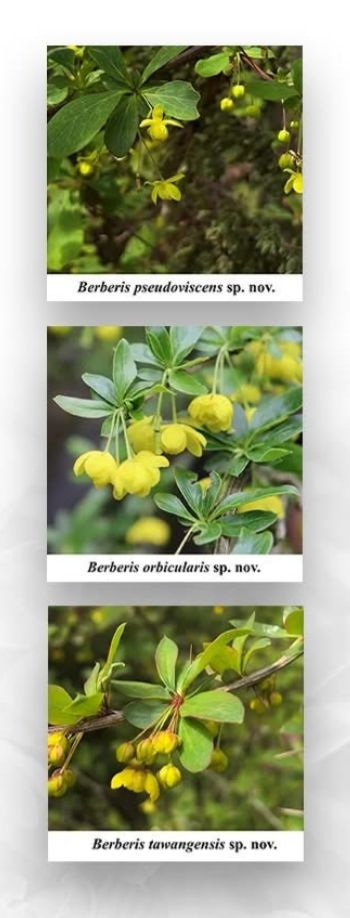
In a significant addition to India’s botanical inventory, scientists have described three new deciduous species of Berberis from the high altitude forests of Arunachal Pradesh, reaffirming the state’s role as a frontier of undiscovered biodiversity in the Eastern Himalaya.
The species, Berberis pseudovirescens, Berberis orbicularis, and Berberis tawangensis, were identified during extensive field explorations in Tawang and West Kameng districts by Bipankar Hajong and Dr. Pankaj Bharali of the CSIR-North East Institute of Science and Technology, Jorhat. Their taxonomic description appears in the 2026 edition of the peer reviewed Nordic Journal of Botany.
The research team documented the plants across temperate broadleaved and mixed conifer forests, typically between 2,000 and 3,200 metres above sea level. Berberis tawangensis, named after its type locality, was recorded from rocky slopes and forest margins in Tawang district. B. pseudovirescensand and B. orbicularis were collected from moist valley systems and open scrublands in West Kameng.
Morphologically, the three species are deciduous shrubs with distinctive traits. B. pseudovirescens shows narrowly elliptic leaves with prominent venation and pale yellow flowers. B. orbicularis is marked by nearly circular leaves and dense racemes. B. tawangensis bears obovate leaves, reddish shoots, and dark purple berries. Detailed comparisons of leaf shape, spine structure, inflorescence type, and seed morphology confirmed they do not match any of the 400 plus Berberis species known globally. Holotype specimens have been deposited at the CSIR-NEIST herbarium and duplicates sent to national repositories.
Berberis, commonly called barberry, is an ecologically and economically important genus. The shrubs stabilize slopes, provide forage for pollinators, and produce berries consumed by Himalayan birds. Ethnobotanically, roots and stems of several species are sources of berberine, an isoquinoline alkaloid used in traditional medicine for treating gastrointestinal disorders, fever, and skin ailments. Modern pharmacology is investigating berberine and related compounds for antimicrobial, anti diabetic, and anti inflammatory properties.
Dr. Bharali noted that the finds are part of a continuing systematic review of Berberis in Arunachal Pradesh, a landscape now increasingly acknowledged as a major centre for species divergence within the genus.
“While B. pseudovirescens is allied to B. virescens, B. orbicularis shows affinity with B. cooperi, and B. tawangensis resembles B. thomsoniana, each possessing stable diagnostic and genomic characters supporting their recognition as distinct species,” the release said.
All three species are currently assessed as Data Deficient, according to International Union for Conservation of Nature (2022) guidelines that suggest newly described species with limited range and population should be treated as data deficient but potentially threatened.
For local communities, the find reinforces traditional knowledge systems. Monpa and Sherdukpen healers in Tawang and West Kameng have long used wild Berberis for dyes and medicine.